2020-01-14
 507
507

Lesson Plan:
1. "Experiment" and its types
2. Local instrument of experimental research.
3. Experimental data and methods.
4. Methodology of experimental research
Table of contents. The concept of "experiment" and its types.
Before speaking about experimental research, it is important to understand what the experiment is, what its features are and what other methods of cognition are.
These difficulties include, but are not limited to, cognitive and cognitive attitudes as a science approach, sensitive and rational, empirical and theoretical, objectively and subjective.
In other words, practice combines the various aspects of the integrated service, and it defines the complexity of nature and the difficulty of identifying it.
In addition, elements of the cognitive process have an impact on the environment, and the researcher is influenced by different components of society. The analysis of these aspects and the nature of the experiment.
In the form of experiment, the approach approaches, and object-oriented interaction, which is transformed into a subjective purpose and adapted to meet the needs of the person.
The experiment identifies the subject and object of cognitive activity, and also the actions aimed at changing the object.
So, the experiment differs from the previous experiments. Given the above, it should be noted that the experimental feature was not only experimental but also experimental. It consists of elements of natural and artificial nature and serves as a research object.
After making such a device, the researcher examines his work, revises the elements, substitutes them, and so on, that he investigates the active structure of the object
The main purpose of the experiment is to broaden and deepen the theoretical positions as well as the subject of research. Experiments can be natural and artificial.
Natural experiments are characteristic of studying social phenomena in production and in everyday life.As for artificial experiments, they are widely used in technical and other sciences. Depending on the nature of the object or process, the conditions for setting and maintaining experiments are divided into laboratory and production.Laboratory experiments are carried out on special stencil boards, standard instruments and stands using the appropriate equipment. They allow you to get valuable scientific information with little cost. However, the results of experimental studies do not necessarily reflect the direction or process of the process.Production experiments are carried out under specific conditions, taking into account the effects of various environmental factors. Such experiments are much more complicated than laboratory and require a careful planning and planning, depending on the nature of the experiment (the particular process or the object).Industrial research also includes various Field Controls of controlled facilities. Another type of production experiments - a set of materials on a specific subject that is read in enterprises, organizations or institutions in accordance with appropriate methodologies and forms.An experimental technique is being developed to effectively conduct experimental research. It includes the following key steps:▪ development of the plan for the experiment;▪ Selection of measuring instruments and experiments;▪ experimentation;▪ processing and analysis of experimental data.Experiment is an important and time consuming stage of research. Logical tools of experimental research.Experimental facts and methods.The experience relies on a wide range of logical tools. In order to analyze them, we define criteria for selecting descriptive instruments.This criterion may be reflected in the rule of practical basics of logical operations, the process of their modification and change, directly related to the actual objects.Such methods include analysis and synthesis, deduction and induction, generalization and abstraction, similarity and modeling operations. Moreover, it should be borne in mind that the experiment has a theoretical and empirical reason and is closely related to the problem with which the hypothesis is tested.In the methodological literature, analysis is defined as the method of scientific knowledge, along with the disassembly of the object and its separate reading.Synthesis is a reverse operation - a combination of whole particles and a study of the full functioning of the object. An objective platform of these methods is the structural organization of material objects, the ability to integrate in complex complexes, interact with one another and break into parts. In this sense, the special meaning is the human activity itself, through which the true objects are separated from each other.Any experimental installation is an experimental version of analysis and synthesis, because on the one hand, it reduces the phenomena investigated from natural compounds and, on the other hand, enters into a new system of elements that make up its installation.Many variations of practice mean that practical implementation of analysis and synthesis, isolation of object's properties and their integration in the whole education. Analytical and synthetic activity analysis in experimental studies is characterized by the fact that the experimental actions of synthesis and synthesis are supplemented by rational forms of expression (logical conclusions of rational form of consciousness).The process of forming various objects and devices in the experimental unit is an experimental synthesis that has been investigated and analyzed by its individual properties and attributes. Then they are synthesized by rational methods in the whole phenomenon. The hypothesis will always require experimental synthesis and experimental testing to build a device.An experimental synthesis, incorporating the elements of an experimental device, is specifically designed to analyze the tested matter. One experiment is usually insufficient. The depth of analysis is directly related to the number of observations. The scope of the disciplines studied is the creativity of the scientist. Deeper analysis allows us to make important news stories. Thus, analysis and synthesis of pilot studies plays an important role as one of the most effective means of cognition, among other methods, analogy, comparison of induction and deductions, not isolation, but close harmony is used.Any analysis and synthesis, comparisons and deductions can not be made without induction, such logical operations are the inclusion of abstractions and digestive elements. The combination of these methods is the basis of scientific analysis and synthesis. Consider them in more detail.The role of induction and deduction will improve knowledge. Let's look at his description of the structure of empirical cognition. These methods are a common bond between knowledge of the individual and man, and their mutual agreement is widely used on theoretical and empirical levels.Induction is the synthesis of personal opinions, on the basis of which the general conditions are created.Deduction is a combination of general and special words that give a logical way of teaching a new personalized speech.The special role of the reduction in its initial stage is formed by the problems and hypotheses that are facing the experimental search and their empirical implications. Ultimately, empirical information, which is formed within the framework of accumulated knowledge of proper understanding of experimental actions, includes the use of deductible operations.In some cases, the results of the study can not be derived from the hypothesis at the time of the analysis.The consequences can be explained by the following facts:1) false hypothesis;2) error when leaving the hypothesis;3) In the experiment itself, there is an inconsistency in the data received. The practice includes analysis and synthesis, induction and deduction for the coordination of theoretical and cognitive, practical teaching tools.Deduction, which allows you to create a certain word, is closely related to the work of the abstraction because the choice of the phenomenon arises from a number of other features that are objectively characteristic of the subject matter. The peculiarity of abstraction in experimental researches is that this cognitive intelligence will have an obviously defined practical approach. The objective set of the sacred properties of the research can be divided not only by theoretical but also by experimentsAbstraction as a hypothesis method, empirical basis - to think about the scheme of practice, the selection of elements of instrumentation, data processing and so on.The similarity is widely used in the experiment - cognitive perception, with the help of which it is possible to switch from one of the common characteristics to the least studied object.The importance of similarity in practice is based on the results of the experimental research on the basis of the study of natural objects. With the help of analogue, they pass from personal information to the whole, from precision to abstract. An experimental change of a single character can be a specific valueFrom the aforementioned, logical operations in experiments have special rational and practical coloring, give practical meaning to practical use, strengthen the complex of actions on the integrated structure of experimental studies, and ensure its connection with the theoretical premises.
The experimental fact lies in the fact that the scientist interacts with changes in the subject of cognition, since any cognitive change in the subject matter of the cognition is justified by the researcher.
Consequently, the experimental fact is the cognitive changes in the object of education approved by the researcher.
At any time in the development of the scientific field, the existing scientific arsenal is a set of definite changes (objects of learning) that have been acquired with a certain historical sequence.
Experimental data occurs when the theory, hypothesis and experimental devices are constructed at the beginning. Another reason for increasing interest in data issues was the development of science that explores the objects of biological and social complexity.
Applying for cognitive changes in the object of learning is performed in a simple operation. Therefore, it can not be considered in the system of "thinking." The researcher's idea distinguishes cognitive changes in the object of learning and corrects it in the form of the image system. Changes in the form of education are recorded by thinking. It is also clear that the interpretation of experimental data can not be a means of proving or denying the theory.
The model of cognitive changes in the subject of recognition should be described in natural or artificial language.
Experimental methods - the schematic diagram of the researcher defined by the experimental structure. The structure of the experiment can be studied at different levels. In this regard, the ways we fix it are, to some extent, characterized. Considering the overall structure of the experiment, it helps to regulate the work of a typical experimental researcher.
This is a widespread and versatile scheme. Further deployment of experimental methods leads to isolation of experimental procedures specific to specific research areas.
Along with the experiment in the cognitive cycle, every simple act involves counting and measurement processes. In this regard, specific calculations and measurement methods appear. However, counting and measurement are the necessary processes in the development of science, but we force them to abstract. Calculation and measurement procedures complement the experimental procedures.
The experimental results should be studied independently of mathematical processing. The study of the independent research procedure in the methodology is a prerequisite for the study of a set of methods used in one or more cognitive cycles.
Control questions:
1. How is an experimental study conducted?
2. How do laboratory experiments take place?
3. The main stages of the practice methodology.
3. Logical tools of experimental research.
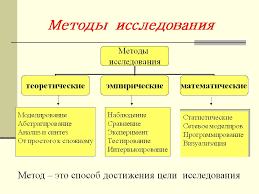
Lecture # 9Topic: Classification of the methods used in the research Purpose of the lesson: To study the methods of experimental researchLesson Plan:1. "Experiment" and its types2. Local instrument of experimental research.3. Practical data.4. Methodology of experimental research. It is a scientific method aimed at distinguishing the entire set of objects by classification and their integration into groups based on some indicators.The main types of classification are typology, taxonomy and taxology. If the classification symbol is important, the topology occurs. An unimportant (but possibly convenient) indicator - the classification is artificial. Systematics enters an ideological system about a certain set of objects.Research has developed many ways to conduct individual research periods. The definite classification as shown in the table. 1, based on certain criteria criteria, allowing you to distinguish between methods.The other possible classification is shown in the table.Common and commonly used methods of research in the field of modern science. They act as intermediate methodologies between fundamental theoretical and methodological principles of philosophy and special science. For general scientific concepts such as "information", "model", "model", "function", "system", "element", "optimism", "probability" such as concepts frequently.The concepts of general scientific concepts, first of all their "united" and personal qualities, features, a clear understanding of certain sciences and philosophical categories. Second, the possibility of their formalization (unlike the latter), the mathematical theory, the symbolic refinement of logic.In particular, often scientific methods - a combination of techniques, methods of knowledge, research methods and procedures used in certain science, corresponds to this basic form of the motion of matterThese are the methods of mechanics, physics, chemistry, biology, social and human sciences. Disciplinary methods are a system of methods used in specific science disciplines, which are a part of the science domain or that occur in science. Each core science - a complex of subjects, individual methods of studying.The widespread use of these methods is the implementation of comprehensive scientific programsMethodology - complex, dynamic, coherent, systematic subordinate methods, approaches, principles of different levels, direction of action, direction, heuristic capacity, content, structure, etc.Directions of development of research and analytical methods in the sphere of services. In the sphere of services, consumer discounts and customer satisfaction are often the result of bilateral relations between the buyer and the seller in the service process.Therefore, drawing a chart of relationships between the customer and the seller is the easiest way to define a "profit basket" in the customer service.Lynn Shostak, an American practitioner and marketing consultant, presented the diagrammatic design methodology. L. Shostak considers the most effective way to provide marketing services, which reflects the entire process of manufacturing processes, as well as the seller and the service, and all tasks directly related to this process.In accordance with the diagram design technology, it is important to distinguish between the task pane and the user's visibility bar.In the visible part of the chart the stages of the service process and tasks to be performed are analyzed.In the invisible part of the diagram, it analyzes and solves problems in production.Processes are interrelated, variable, and controlled, while tasks are interchangeable. As a simple example, L. Shostak offers production of service diagram "Order of flowers by phone". Other examples of the diagram show consumers' well-functioning service in fast-food restaurants, such as McDonald's and Sabwe.For example, McDonald's, a well-developed service process, believes that the production of burger products should be hidden from consumers' eyes.Strategic alternative to this approach is Sabwei's restaurants network, where it believes food and service industries should be consumed only by consumers, ie in the vicinity. Both methods have a solid marketing foundation.In the first case, the process of rapid cooking of the hamburgers, by frostbite in the microwave oven from consumers, partly reflects the fact that the finished product is made of new products only by customers.The disadvantage of the graphic design methodology, in our opinion, is excessive in the invisible part of the service production process.The essential part of the process for the consumer, ie the level of direct service, in the final analysis, without diminishing the importance of pure technological aspects of production, which is regarded as the service mark. This part of the process illustrates the quality of the service quality of the service quality, or how the consumer accepts the service. Consumer methodAnother way to identify a customer's "basket of benefits" and to build a process of interaction between the buyer and the seller - sometimes the consumer scenario method is also called the "customer protocol".The technology of the method is very simple and pragmatic: besides the development of the stages and tasks of the service process, the marketing manager may ask the customers themselves to perform the task.Consumers (in individual or small groups) are encouraged to describe the service process or create a "script" that is documented in the form of a protocol.Then he asks the customer to evaluate the service process and make suggestions on how to improve it. The advantage of this method is that it identifies the strengths and weaknesses of the service process used by the firm during the process of the protocol. Based on this protocol, you can develop a new service scenario or idea of a new service.This method is very compatible with marketing philosophy because it is a customer, not a firm that decides how to serve customers. By analyzing the scenario, the firm makes strategic decisions to influence consumer behavior and increase the cost effectiveness of the service process. For example, every visitor to McDonald's restaurants can rebuild scenarios of the visible part of the service process taken at these restaurants.Also, the company reduces the cost of labor and service in a company by putting consumers into their garbage cans. Another advantage of this method is to verify the efficiency and effectiveness of individual steps and tasks of the service process.For example, the American Delta Airline, which seeks to improve the quality of airline service, has undertaken additional safeguards in this process.When registering passengers from the airline, besides routine check-in procedures, every passenger issues a standard set of questions about where, with whom, when, and under what circumstances, baggage, baggage.Improve service quality and maintain the safety of passengers The result of maintenance was complicated and time consuming.Passenger registration has become a repeat of customs control and caused many airline's dissatisfactionUsing the Consumer Scenario Method allows the marketing manager and passengers to determine whether they have a different understanding of the required service process, and this is a serious mistake of the manager.The lack of a consumer-friendly scenario is a problem that can only be addressed to consumers of the service process.Invisible, or relative, part of the maintenance process is a logical extension or reference to its visible part. It is important to analyze the strengths and weaknesses of the whole service process, including visible and invisible parts.Please note that when using this method an invisible part of the service activity will be left out of the customer's comment box. Therefore, marketing experts recommend that this method be adapted to the internal environment of the company, which is not visible to the consumer segment of the business process, ie in combination with the method of reconstruction. Control questions:1. What are the criteria for the classification of research methods?2. How do you see differences between the common scientific and non-interdisciplinary approaches?3. What does it mean to check the results of the study?4.What methods of research do you know?
Lecture 10.